OEM vs. Standard Sizes: Choosing the Right Wood Cabinet Supply for US Multi-Family Projects
OEM vs. Standard Sizes: Choosing the Right Wood Cabinet Supply for US Multi-Family Projects
Meta Description: A developer's guide to cabinet supply strategies for US multi-family projects. Compare OEM (custom-fabricated) vs. standard-size cabinets on cost, lead time, quality, and project suitability.
Introduction: The Scale & Precision Challenge in Multi-Family Development
For developers, general contractors, and procurement managers overseeing US multi-family projects—from urban mid-rises to sprawling suburban complexes—the cabinet specification process is a high-stakes logistical and financial decision. Wood cabinetry, a top-five cost center in unit finishes, must balance perceived quality for tenants and buyers, strict budget adherence, and installation efficiency across dozens or hundreds of identical units. The core strategic choice lies between OEM (Original Equipment Manufacturer) custom-fabricated cabinets and pre-manufactured standard-size cabinets. This decision impacts everything from initial capital outlay to the final punch list, defining both project profitability and end-user satisfaction.
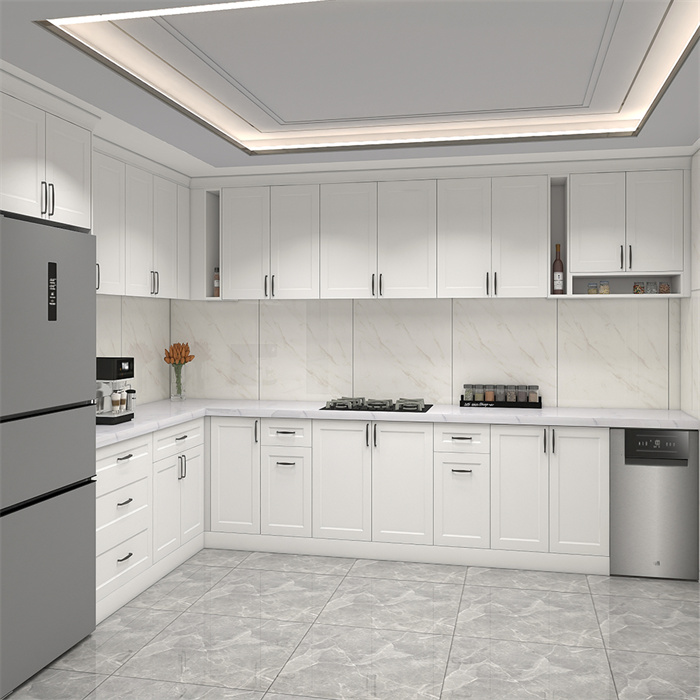
Part 1: Defining the Two Supply Models
Standard Size (Stock/Semi-Custom) Cabinets
What They Are: Cabinets manufactured in a finite set of predetermined widths (e.g., 9", 12", 15", 18", 24", 30", 33", 36"), depths, and heights. They are produced in large batches based on forecasted demand.
Supply Chain: Typically sourced from large manufacturers (KraftMaid, American Woodmark, Ikea) via distributors or big-box retailers. Design is limited to the manufacturer's available door styles, finishes, and accessory options within the modular system.
The Multi-Family Fit: The "kit of parts" approach. Units are designed around these fixed sizes, using filler strips and panels to adapt to actual wall dimensions.
OEM (Original Equipment Manufacturer) Cabinets
What They Are: Cabinets custom-built to the exact millimeter specifications of the project. The developer provides detailed shop drawings, and the OEM fabricates cabinets tailored to each unique floor plan and elevation.
Supply Chain: A direct relationship with a specialized manufacturing facility, often a regional shop. The developer or their millwork partner provides precise digital specs, and the OEM executes the fabrication.
The Multi-Family Fit: The "tailor-made" approach. The building's design dictates the cabinet sizes, not the other way around.
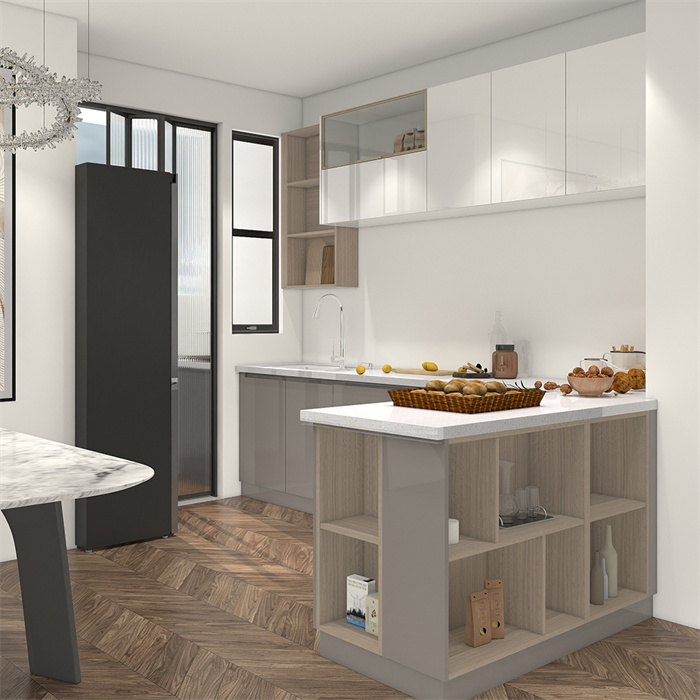
Part 2: Head-to-Head Comparative Analysis
| Decision Factor | Standard Size Cabinets | OEM (Custom-Fabricated) Cabinets |
|---|---|---|
| Unit Cost & Budget Control | ✅ Lower Base Cost. Economies of scale from mass production. Predictable, itemized per-unit pricing. Ideal for tight, fixed budgets. | ❌ Higher Base Cost. Labor and material optimized per unit, not for bulk. Premium for exact sizing and unlimited design. |
| Project Lead Time | ✅ Shorter & More Predictable. Inventory may be on-hand; semi-custom lines have set production cycles (4-8 weeks). Simplifies scheduling. | ❌ Longer & Variable. Entire production is project-specific (8-16 weeks). Entire cabinet package is on the critical path; any design change causes major delays. |
| Design Flexibility & Space Optimization | ❌ Limited. Must design floor plans around available sizes. Results in filler strips (~2-4" per run) and potentially compromised storage efficiency. "One size fits none" perfectly. | ✅ Maximum. Every inch of space is utilized. Cabinets fit wall-to-wall and floor-to-ceiling with no wasted gaps. Enables unique, high-end finishes that differentiate units. |
| Material & Construction Quality | Variable. Ranges from builder-grade (particleboard boxes) to premium (plywood boxes, dovetail drawers). Consistency is high within a product line. | ✅ Controllable & Often Superior. Can specify exact materials (e.g., all plywood boxes, 5-piece solid wood doors, brand-specific hardware). Quality depends on the chosen OEM's standards. |
| Logistics & Installation | ✅ Streamlined. Delivered as modular boxes. Easier to warehouse, stage, and install. Crews can work faster with familiar, repetitive systems. Damage replacement is faster. | ❌ More Complex. Delivered as a precise jigsaw puzzle for each unit. Requires meticulous handling, skilled installers, and perfect site conditions. A single damaged piece can halt work. |
| Warranty & Accountability | Manufacturer-Centric. Warranty claims go through the manufacturer/distributor. Resolution can be slow but is systemized. | Single-Point Accountability. The OEM (and by extension, the GC) is solely responsible for fabrication errors, allowing for direct, faster resolution but also concentrated risk. |
Part 3: Strategic Decision Matrix: Which Model Fits Your Project?
The right choice is dictated by project class, unit density, and market positioning.
| Project Profile | Recommended Model | Strategic Rationale |
|---|---|---|
| Class A / Luxury High-Rise | OEM | Market differentiation is key. Premium buyers expect seamless, built-in quality and maximal space efficiency. The cost premium is justified by higher rents/sale prices. |
| Large-Scale Class B Garden-Style or Mid-Rise | Standard Size (Semi-Custom) | The sweet spot. Balances quality perception with cost control across hundreds of units. Speed and install efficiency are paramount to cash flow. |
| Affordable / Workforce Housing | Standard Size (Stock) | Absolute cost minimization is the driver. Standard 30" and 36" sink bases, 24" uppers, and 33" oven cabinets meet code and function. Filler strips are an accepted trade-off. |
| Adaptive Reuse / Historic Renovation | OEM | Irregular walls, non-standard ceiling heights, and unique layouts make standard sizes impractical and wasteful. Custom fabrication is the only way to achieve a quality finish. |
| Student / Micro-Unit Housing | OEM or Hybrid | Every square inch is revenue-generating. Custom sizing maximizes minimal space. A hybrid approach (custom boxes, standard doors) can optimize cost. |
Part 4: The Hybrid Approach: Blending OEM & Standard for Optimal Value
Increasingly, savvy developers employ a hybrid strategy to capture the benefits of both models:
OEM Boxes with Standard Doors: Specify custom-sized cabinet boxes (carcasses) to achieve perfect, filler-free fits for each floor plan. Then source standard-sized door and drawer fronts from a major manufacturer's catalog. This optimizes space while controlling the cost of the most visually prominent component.
Standard Perimeter with Custom Features: Use standard cabinets for all common, repetitive runs (perimeter uppers and lowers) and employ OEM fabrication only for complex, high-impact areas like master bathroom vanities, built-in laundry centers, or feature islands.
OEM for Millwork Integration: Use the OEM to fabricate cabinets that are integrated with other millwork (e.g., a continuous run of cabinetry that includes a kitchenette, wardrobe, and desk in a micro-unit).
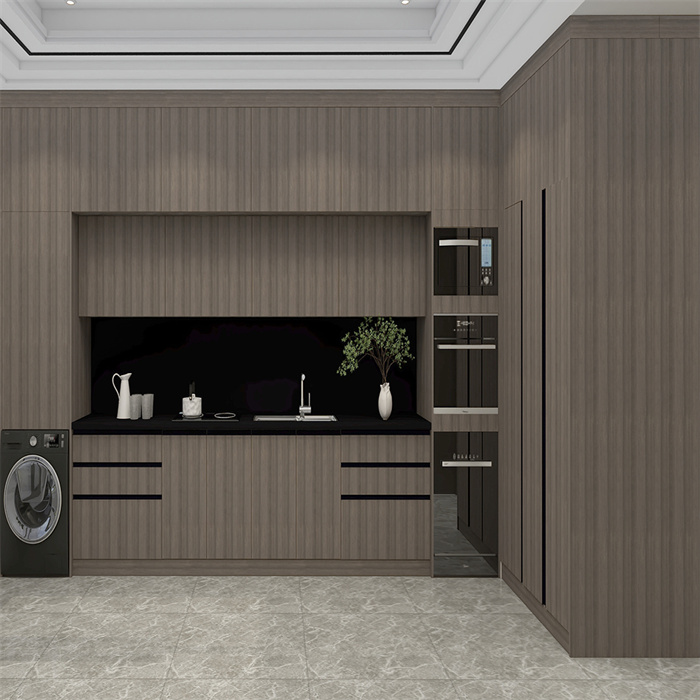
Part 5: Implementation Checklist for Project Teams
For Standard Size Procurement:
Lock Floor Plans Early: Finalize unit layouts around standard cabinet modules to minimize filler.
Bulk Order with Staggered Delivery: Negotiate volume discounts and schedule deliveries in phases to manage on-site storage.
Order Significant Overage: A standard 5-10% overage for damage/defects is cheaper than a stalled installation waiting on one replacement part.
For OEM Procurement:
Vet the Manufacturer Rigorously: Require plant tours, financial references, and examples of past multi-family projects of similar scale.
Invest in Perfect Documentation: Shop drawings must be 100% accurate and include every detail, including plumbing/electrical knockouts. The rule is "Garbage in, garbage out."
Prototype a Unit: Fully install cabinets in a mock-up unit first. This catches design and fabrication flaws before full-scale production begins.
Secure the Logistics Chain: Plan for secure, climate-controlled staging and a detailed system for sorting and distributing cabinets to each unit.
Conclusion: Aligning Supply Strategy with Project DNA
The choice between OEM and standard-size cabinet supply is a fundamental business decision that reflects the project's priorities. Standard sizes offer the efficiency and cost certainty of a production line, ideal for volume-driven developments where speed and budget are king. OEM fabrication offers the precision and premium fit of a tailor, critical for projects where space optimization and luxury finish are the primary value drivers.
In today's market, the most successful multi-family teams are those that move beyond a one-size-fits-all mentality. They analyze each project's specific financial model, target demographic, and architectural constraints to select—or blend—the cabinet supply strategy that delivers the optimal balance of cost, quality, and time. By making this decision with the same rigor applied to structural or mechanical systems, developers protect their margin and ensure their finished product meets the market's exacting demands.
Final Due Diligence Question: "Does the cost premium of OEM cabinets, as a percentage of our total unit hard costs, justify the potential for increased rent premiums or faster lease-up/sales absorption?" If the answer is quantifiably "yes," custom fabrication is an investment. If not, a well-specified standard product is the sound business choice.
How to buy kitchen cabinets? ➡
Exclusive Interview with Homeowner ➡
Struggling to turn around in your kitchen? ➡
Is the trend towards "de-living-rooming" design catching on? ➡